Prioritise at regional scale.
Review the Transformation Index, then discuss the buildings and decision thresholds relevant to your region.
See your region →The EU set the goal in 2020, yet the annual energy-renovation rate remains around 1%. EGG reconstructs how stress has accumulated in a building's elements without an initial site visit—producing a screening verdict, a renovation proposal with a likely cost range, and a forecast of how each element degrades from here. A roof with five years left is a different decision from one with twenty.
EU sources: Renovation Wave Energy renovation rate
NEST — Non-invasive Element-based Stress Twin.
It builds an element-based twin of a building from its drawings and reads how stress has accumulated in each element — without opening a wall.
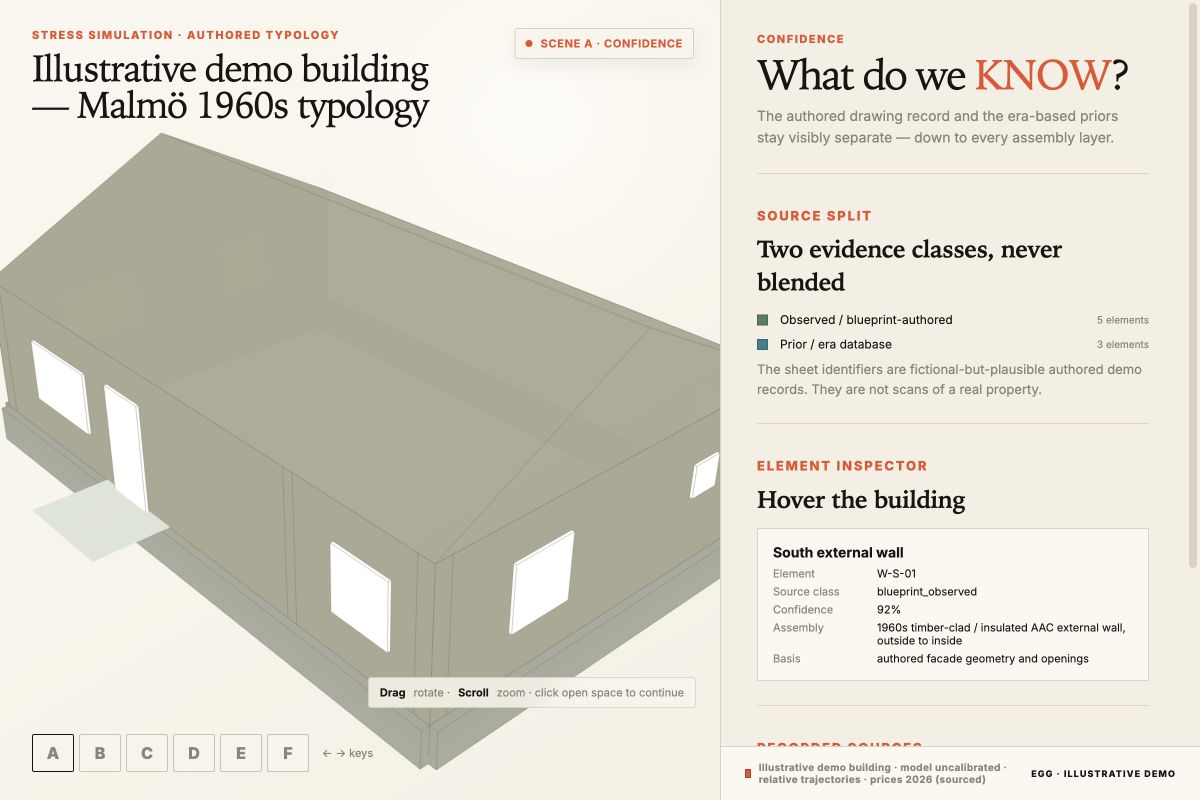
Illustrative model of a Malmö 1960s typology — not a surveyed property.
The Transformation Index organises 92,671 buildings across Sweden's 21 regions into a screening view for portfolio and programme decisions. It is a regional prioritisation layer—not a substitute for an asset-level engineering review.























EGG is led by founder Andrej Hurta. We publish the method's provenance, calibration status and current limits so institutional readers can judge the work on its evidence.
Meet the founder and see current research discussions →Review the Transformation Index, then discuss the buildings and decision thresholds relevant to your region.
See your region →Follow the environmental layers, degradation models and sensitivity analysis behind the screening verdict.
Read the methodology →Talk through provenance, uncertainty and how a condition signal could support—not replace—credit and engineering review.
Talk to Andrej →The workflow extracts geometry, materials and missing-data zones from drawings, engineering drawings, scans and other available records, attaching a confidence coefficient to each element. It then replays environmental signals through established material models: Tuutti/Fagerlund for concrete, Vesikari for masonry and ISO 9223 for steel. The extraction is AI-assisted and human-reviewed.
Accuracy depends on the quality and completeness of the source records. Incomplete drawings, an incorrectly inferred material or missing climate data can move the result; the current sensitivity example shows mortar condition changing from 55 to 20 across the illustrated freeze-thaw range. Element-level confidence and human review identify where targeted verification is needed, and the present condition scale remains illustrative and uncalibrated—not an asset verdict.
Draft—human review required. The existing methodology pages show a BIM-ready model, element-level condition trajectories and intervention comparisons, but they do not define the contracted deliverable, file formats or reporting package. Those terms must be confirmed before publication.
The remote assessment is a screening and prioritisation layer, not a replacement for a detailed on-site engineering review. It uses existing records and environmental history to reconstruct element-level stress; a traditional survey observes conditions that can be inspected on site today. Confidence flags and human review indicate where a later visit should concentrate.
Draft—human review required. Blind Scanning says the workflow can combine architectural drawings, engineering drawings, PDFs, scans, photos and records, but the site does not define which inputs are mandatory, their minimum quality or the process when records are missing. Project intake requirements must be confirmed before publication.